If you are planning a tiling project in India, you might have noticed that the days of using simple cement-sand slurry are fading. Today, Tile Adhesives are the gold standard. But walking into a hardware store can be confusing—you’ll see bags marked “Type 1,” “Type 2,” or “S1.”
What do these mean? And more importantly, which one should you choose?
This guide breaks down IS 15477:2019, the official Bureau of Indian Standards (BIS) code that governs tile adhesives. By the end of this post, you’ll know exactly which grade you need to ensure your tiles stick for a lifetime.
Why the Standard Changed
In 2019, the Bureau of Indian Standards updated the old 2004 code to keep up with modern tile trends. We no longer just use small ceramic tiles; we now use massive vitrified slabs, glass mosaics, and natural stones on various surfaces like plywood and drywall.
The new standard classifies adhesives into five specific types (Type 1 to Type 5) based on their Chemical Composition and Mechanical Properties (like strength and flexibility).
- Chemical Composition
- Tensile Adhesion Strength
- Shear Strength
- Flexibility (Deformability)
The 5 Grades of Tile Adhesive Explained
Here is the breakdown of the five types of adhesives defined under IS 15477:2019.
1. Type 1: The General Purpose Adhesive
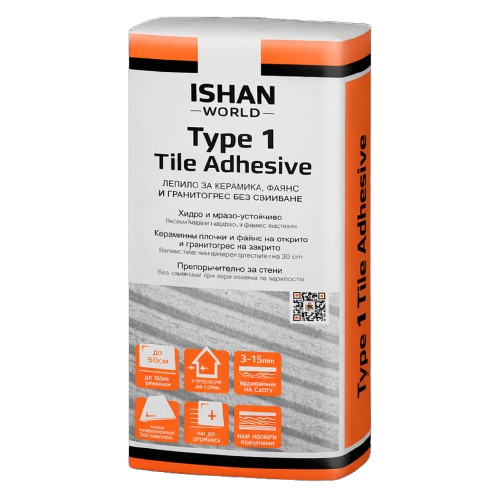
This is the most basic polymer-modified adhesive. It relies largely on mechanical bonding.
- Best For: Porous tiles like Ceramic or Clay tiles and Small format stones.
- Application: Interior floors and walls.
- Condition: Dry areas only (Bedroom, Living room).
- Tile Size Limit: Generally up to 300mm x 300mm.
- Technical Spec: Tensile Adhesion Strength ≥ 0.5 N/mm².
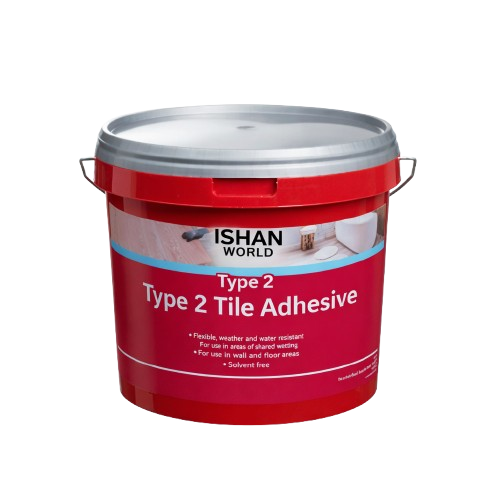
2. Type 2: The “Premium” Interior/Exterior Adhesive
This grade has a higher polymer content, allowing it to bond chemically with low-porosity surfaces.
- Tile Size Limit: Works well for standard sizes (e.g., 600mm x 600mm).
- Technical Spec: Tensile Adhesion Strength ≥ 1.0 N/mm².
- Best For: Vitrified tiles, fully vitrified tiles, and Glass Mosaics.
- Application: Interior (Floor & Wall) and Exterior (Floor only).
- Condition: Wet areas like Bathrooms, Kitchens, and Balconies.
3. Type 3: The Exterior Wall Specialist
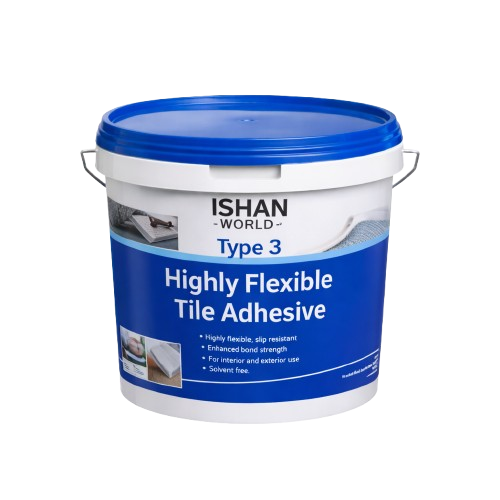
Gravity is the enemy of wall tiles. Type 3 adhesives are formulated to hold heavier tiles on vertical exterior surfaces without slipping or de-bonding due to heat and rain.
- Technical Spec: Shear Adhesion Strength ≥ 1.5 N/mm
- Best For: Ceramic, Clay, Basalt, Vitrified, and Natural Stone.
- Application: Exterior Walls (Facades) and concrete substrates.
- Condition: Extreme weather exposure (Rain, direct sunlight).
4. Type 4: The Drywall & Plywood Specialist
Standard cement adhesives cannot stick to wood or gypsum because these materials vibrate and flex. Type 4 is highly flexible to absorb these movements.
- Deformability: Must meet S1 or S2 standards (see below) depending on tile size.
- Best For: Any tile installed on “Dry” substrates.
- Substrates: Plywood, Gypsum Board, Cement Board, Medium Density Fibre (MDF).
- Application: Interior partitions, wooden sub-floors.

5. Type 5: The Toughest Bond (Metal & Glass)
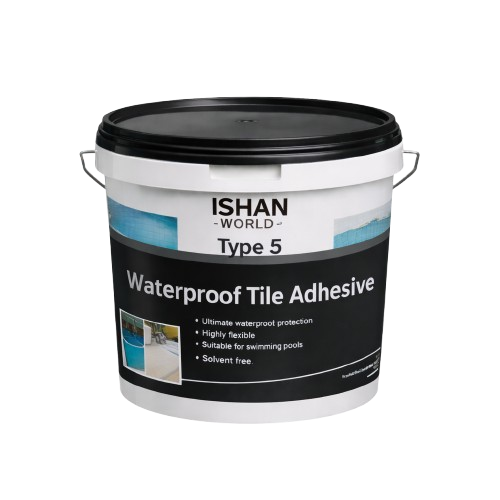
This is the “nuclear option” of adhesives. It is often a synthetic resin-based adhesive (like Epoxy or Polyurethane) rather than standard cement.
- Technical Spec: Shear Adhesion Strength ≥ 6.0 N/mm² (Extremely high).
- Best For: Engineered stones, Metal tiles, or synthetic materials.
- Substrates: Metal surfaces (Grid iron, Steel, Aluminum), Glass.
- Application: Elevators, industrial areas, modern architectural features.
Decoding the “S” Classes: Flexibility Matters
For Type 4 adhesives (and sometimes others), you will see an “S” rating.4 This refers to Transverse Deformation—or how much the adhesive can bend before it cracks.
- S1 (Deformable): Can bend between 2.5mm and 5mm. Required for tiles larger than 600mm x 600mm on drywall.
- S2 (Highly Deformable): Can bend more than 5mm. Required for massive slabs (e.g., 1200mm x 1200mm) or substrates with high vibration/movement.
Summary Comparison Chart
| Grade | Primary Use | Tile Porosity | Adhesion Strength (Min) |
|---|---|---|---|
| Type 1 | Ceramics, Clay (Interior Dry) | > 3% (High) | 0.5 N/mm² |
| Type 2 | Vitrified, Glass Mosaic (Wet Areas) | < 3% (Low) | 1.0 N/mm² |
| Type 3 | Exterior Wall Cladding | Any | 1.5 N/mm² |
| Type 4 | Drywall (Plywood/Gypsum) | Any | 1.5 N/mm² |
| Type 5 | Metal & Glass Substrates | Any | 2.0 N/mm² (Tensile) / 6.0 (Shear) |
Conclusion: How to Choose?
Choosing the wrong grade is the #1 reason for “popping” tiles and hollow sounds.
- Renovating a Bathroom? Use Type 2.
- Tiling a Bedroom Floor (Ceramic)? Type 1 is sufficient.
- Cladding the Front of Your House? Never compromise—use Type 3.
- Sticking Tiles to a Plywood Cabinet? You need Type 4.
Always check the bag for the IS 15477:2019 mark to ensure you are getting a product that has been rigorously tested for Indian construction conditions.
Why Choose ISHAN WORLD
When it comes to selecting the right tiles, sanitaryware, bathware, and bath fittings, ISHAN WORLD stands out as a trusted, all-in-one destination for quality, variety, and value. We offer a carefully curated selection of ceramic, porcelain, vitrified, double charge, and full body tiles—sourced from top manufacturing units using the latest technologies.
At ISHAN WORLD, we believe that every space deserves the perfect combination of design, durability, and price. Whether you’re building your dream home, renovating a bathroom, or designing a commercial project, our products match every taste and requirement. From elegant matt finishes to luxury sugar and carving tiles, we provide choices that are both aesthetic and functional.
Our expert guidance, transparent sourcing, and competitive pricing make tile selection easy and hassle-free. We don’t just sell tiles—we help you make informed decisions. Visit ISHAN WORLD today and experience the difference in quality, service, and style.
Join hands with one of India’s fastest-growing tile brands – Ishan World – and build a successful, hassle-free business with our FOFO model, PAS facility, expert support, and exclusive product range designed for modern India.
Connect with ISHAN WORLD to explore hallway tiles in many designs and styles, and create a welcoming and memorable hallway to make lasting impressions.
ISHAN WORLD – Build Beautiful. Live Better.
Contact Us : 7078270782
Visit Us : www.ishanworld.com
Write Us : info@ishanworld.com
Visit our social media handles
Instagram : Click here
Facebook : Click here
Whatsapp: Click here
Pinterest : Click here
Twitter : Click here
Youtube : Click here
Blogspot : Click here
Quora : Click here
Medium :Click here
LinkedIn : Click here
Divya Store : Click Here
Navya Store : Click Here
Express Store : Click Here For Sewla , Click Here For Firozabad
Frequently Asked Questions
1) What is the Indian Standard that defines tile adhesive grades in India?
Tile adhesives in India are classified under IS 15477:2019 (Adhesives for Use with Ceramic Tiles and Mosaics). This standard classifies adhesives into Type 1 to Type 5 primarily based on minimum tensile adhesion strength and shear adhesion strength under different conditions (dry, wet, heat aging).
2) What do “Type 1” to “Type 5” actually mean—how are they different?
In IS 15477:2019, the “Type” indicates the performance class (bond strength and durability). In simple terms:
- Type 1: basic cementitious adhesive for small, porous ceramic tiles in interior dry areas (lower bond-strength requirements).
- Type 2: improved adhesive for low-porosity tiles (like vitrified/porcelain) and more demanding conditions including wet areas.
- Type 3: higher-performance adhesive commonly used for exterior wall applications (more severe exposure).
- Type 4: for drywall/board substrates (gypsum boards, plywood, cement boards, etc.), where some movement is expected.
- Type 5: reactive resin adhesives (e.g., epoxy-type systems) with much higher shear strength for special applications.
This classification is backed by the standard’s minimum tensile/shear adhesion criteria and practical suitability guidance.
3) What are the minimum bond strength requirements in IS 15477:2019?
IS 15477:2019 specifies minimum tensile adhesion strength and shear adhesion strength thresholds by type. For example (selected key values):
- Tensile adhesion strength (dry), minimum:
Type 1: 0.5 N/mm², Type 2: 1.0, Type 3: 1.5, Type 4: 1.5, Type 5: 2.0 - Shear adhesion strength (dry), minimum:
Type 1: 1.0 N/mm², Type 2: 1.25, Type 3: 1.5, Type 4: 1.5, Type 5: 6.0
The standard also includes wet/heat-aging conditions (important for bathrooms, exteriors, terraces, etc.).
4) What is the “slip” requirement, and why does it matter for wall tiles?
“Slip” (sag) is mainly relevant for vertical applications—it measures how much a tile slides down after installation. As per IS 15477:2019, when tested by the standard method, slip should not be more than 0.5 mm.
Why it matters: if slip is high, tiles can droop, grout lines become uneven, and heavy wall tiles may slowly creep down before the adhesive sets.
5) How do I choose the correct IS 15477 “Type” for my project (quick rules)?
A practical selection approach aligned with the intent of IS 15477:2019:
- Small ceramic wall/floor tiles in a dry room: usually Type 1 is adequate.
- Vitrified/porcelain tiles, bathrooms, kitchens, wet zones: generally Type 2 or higher.
- Exterior wall cladding / elevations exposed to weather: commonly Type 3.
- Gypsum boards, plywood, cement boards, bison panel (drywall systems): Type 4 (designed for such substrates).
- Industrial areas / chemical exposure / special substrates: Type 5 reactive resin systems may be used.